
What Is an Ostomy Reversal?
First, what is an ostomy?
An ostomy is a surgically created opening (a stoma) on the abdomen that allows urine or stool to exit the body when the natural pathway is blocked or damaged, rerouting waste into an external pouch.
Common types include colostomies (colon), ileostomies (small intestine), and urostomies (urine), often needed for conditions like cancer, inflammatory bowel disease (IBD), or injury. These may be temporary, or permanent.
Our website focuses on the reversal of a colostomy or ileostomy.
Colostomy Vs. Ileostomy
These two types of ostomies are quite different. While both are diversions of the normal digestive process, they occur at different parts of the body.
- Ileostomies are placed in the small intestine, or ileum. They are ‘higher up’ in the digestive system, and are often used when the large bowel that is ‘lower down’ needs to heal. Ileostomies are typically on the right side of the body.
- Colostomies are placed in the large intestine, or colon. They are lower down in the digestive system. Colostomies are typically on the right side of the body.
Each type of ostomy has a purpose, and the one that’s best for your particular needs will be determined by your surgeon. The part of the bowel that is below or ‘after’ the ostomy is referred to as the distal bowel.
What is an Ostomy reversal, or ‘take down’?
When the bowel is reconnected, establishing the normal flow of stool through the digestive system.
The stoma itself is closed in the process, and the opening on the abdomen is either sewn shut or left to close on its own. (This process varies by surgeon).
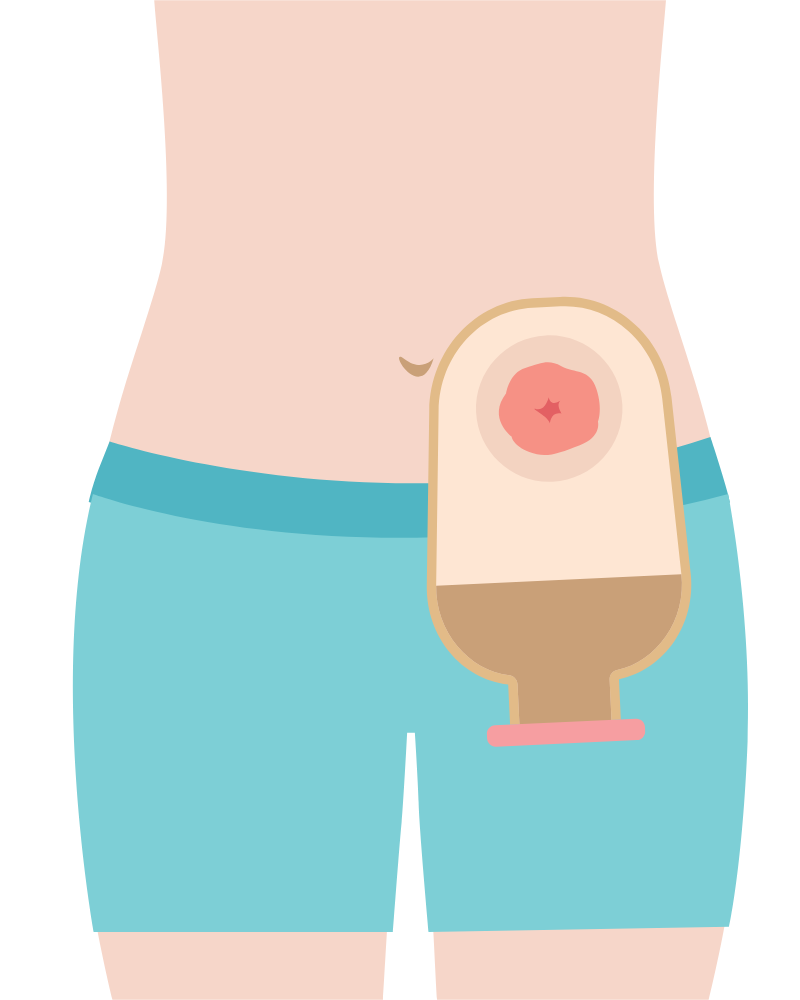
The process of your take down will be determined by your surgeon and your particular health considerations.
If you have had a colostomy, it may be necessary to convert you to an ileostomy for a period of time to allow your bowel to heal from surgery.
This is common in the event of cancer; after tumor removal surgery, the large bowel may need time to heal. So, the waste will be diverted ‘higher up’ in the digestive tract through the use of an ileostomy, allowing the distal bowel to sit unused and to heal for a period of time before the complete reversal occurs.
This interim step is not atypical, and should be discussed with your surgeon as a possibility. A surprising outcome of a colostomy reversal is to wake up with an unexpected ileostomy as a temporary measure! Be sure to talk to your surgeon about whether they are considering this option, or what findings during surgery might make this necessary.